01 / CAPABILITY
All-source intelligence & fusion
Fuse multiple lawful and authorized information streams into one coherent assessment built around a defined decision requirement.
Understand the fusion model →Intelligence Analysis · Investigations · Strategic Advisory
Publius64 is an intelligence analysis, investigations and strategic advisory firm. We integrate open-source intelligence, authorized human reporting, geospatial analysis, investigative research, competitive intelligence, protective intelligence and client-provided information to build decision-ready assessments for executives, organizations, security teams, counsel and strategic decision-makers.
Based in Salt Lake City & Ogden, Utah. Supporting clients across the Wasatch Front and by scope across CONUS and OCONUS operating environments.
ALL-SOURCE INTELLIGENCE / OSINT / INVESTIGATIONS / STRATEGIC ADVISORY
01 / Integrated capabilities
Publius64 combines intelligence analysis, investigations, strategic advisory and protective intelligence. The capability set is broader than executive protection: understand people, organizations, markets, leadership, geography, access and operating environments before decisions are made.
Fuse multiple lawful and authorized information streams into one coherent assessment built around a defined decision requirement.
Understand the fusion model →Protective and executive-protection intelligence for travel, events, exposure, venue context and changing tactical, operational and strategic conditions.
Explore PULSE-EPAssess insider-risk concerns, IP exposure, trusted access, technology-transfer risk, information leakage and potential exploitation pathways.
Protect critical knowledgeReview identity, affiliations, relevant conflicts and access implications around appointments and partnerships.
Examine access & relationshipsConnect people, organizations, records and events through source-validated research and evidence chronologies.
Follow the evidenceAssess competitors, markets, leadership changes, public filings, partnerships and strategic signals to improve decision advantage.
Read the competitive environment →Assess reported surveillance indicators, pre-operational observation, location seeking, repeated presence, digital exposure, schedule leakage and suspicious access behavior.
Evaluate an exposure concernBuild intelligence requirements, reporting procedures, escalation plans and practical OSINT capability.
Build an intelligence programAdd OSINT-led, all-source analytic support to a security team, executive-protection detail, family office, legal team or GSOC through a scoped engagement.
Integrate analyst supportTransform location, movement, infrastructure, incidents, assets and environmental information into spatial intelligence for protective, investigative and strategic decisions.
Put intelligence on the mapTranslate analytic requirements into purpose-built research tools, mapping applications, dashboards and reporting workflows.
Build around your requirementsGeopolitical, foreign-affairs, corporate leadership and public political-actor analysis grounded in records, institutions, decisions and context.
Defined questions. Lawful collection. Source-validated findings. Practical next steps.
How we work02 / All-source intelligence analysis & fusion
All-source intelligence analysis combines multiple lawful and authorized information streams into one coherent assessment. Publius64 fuses information around a defined decision requirement rather than treating every collection discipline as a stand-alone service.
Public records, media, corporate information, public social media, databases, commercial sources, digital research, entity resolution and network analysis.
Authorized interviews, liaison reporting, field observations, witness information, client reporting and other human-derived information evaluated alongside documentary evidence.
Spatial relationships, movement, infrastructure, geographic exposure, incident mapping, travel environments, assets and operating-area analysis.
Lawfully obtained or client-provided technical, RF, communications-environment, telemetry, spectrum and related reporting incorporated when relevant to the decision requirement.
Records, timelines, relationships, affiliations, due diligence, evidentiary chronology, source provenance and alternative-hypothesis testing.
Geopolitical, foreign-affairs, political leadership, corporate leadership, competitive, country and organizational analysis.
PULSE-EP is a specialized application of Publius64’s broader all-source analytic tradecraft to the protectee’s operating environment. The assessment connects OSINT, geospatial context, authorized reporting, leadership and cultural analysis, geopolitical conditions, travel intelligence, network analysis and protective indicators.
The product informs the protectee and protection team: what changed, why it matters, what remains uncertain, and what should trigger a different posture before movement, an event, a transaction or a public appearance.

Colors identify analytic layers—not low, medium or high risk.
Assess time-sensitive threats, exposed schedules, repeated unwanted contact, approach behavior, access attempts and event-specific indicators.
Does this require attention or escalation now?
Connect trips, venues, meetings, hosts, public appearances and information exposure to the planning and coordination they require.
What should change for this trip or engagement?
Examine geopolitical context, business transitions, public narratives, relevant relationships and longer-term changes in exposure.
What could change the operating picture next?
A baseline is a starting point. Each new destination, engagement or material development creates a new question to assess.
Resolve identity, distinguish public prominence from evidence of targeting, review relevant affiliations and establish known exposure. Identify missing information and agree on the protective decisions the assessment must inform.
Evaluate the confirmed activity, host, venue environment, public visibility, access concerns and locally relevant disruption or targeting indicators. Translate findings into advance questions, liaison requirements and proportionate monitoring—not a blanket deployment recommendation.
For international destinations, add geopolitical conditions, cultural expectations, local-source context, business relationships and relevant information-security concerns. Examine their specific implications for the protectee. Nationality, culture and affiliation alone do not establish hostile intent.
A new appearance, public announcement, disclosure or credible incident may change exposure. An agreed update cycle identifies what changed, whether the evidence supports a different posture, who should review it and what would trigger further action. Monitoring scope and cadence are established for each engagement.
CONUS means the contiguous United States. OCONUS means outside the contiguous United States, including Alaska, Hawaii and U.S. territories—not only foreign travel. Protected routes, lodging and private itineraries remain outside public-facing reporting.
Illustrative use case
An executive is preparing for a major business transition and an overseas engagement. The assessment first establishes the exposure baseline, then evaluates transaction publicity, confirmed activity, destination context and information gaps. The recommendation may be targeted monitoring and event-specific preparation rather than standing deployment. New evidence—not prominence alone—drives escalation.
Hypothetical scenario, not a named client engagement, endorsement or live assessment. Findings are bounded by the available sources and review period.
Structured professional judgment
ETF-CI is an insider-threat and risk-assessment app designed to support structured professional judgment. It organizes observable information into a repeatable review of risk, confidence, evidence sufficiency, unknowns, competing explanations, protective factors and proportionate next steps.
The app supports triage, fuller case formulation, intelligence-gap identification and reassessment. It is designed to help authorized reviewers document why a concern warrants additional collection, monitoring, safeguards or closure without turning a score into an accusation.
An 18-item screener helps determine whether the available information warrants a fuller structured review. Screening is intake—not a final finding.
A 62-indicator full assessment organizes relevant observations while preserving source provenance, unknowns and the distinction between evidence and inference.
Coding guidance, minimum-evidence rules and double-counting controls help keep repeated facts from becoming artificial certainty.
Report the risk formulation together with confidence, case stage, alternatives, protective factors and a documented next step, then reassess when conditions change.
03 / Counterintelligence & organizational protection
Publius64 uses counterintelligence-informed analysis to examine how people, partnerships, trusted access and external relationships intersect with critical information. The goal is to identify exposure, suspicious access patterns, intelligence gaps and proportionate safeguards without treating affiliation or access alone as evidence of wrongdoing.
Define the research, trade secrets, commercial information and institutional knowledge that require protection.
Map roles, affiliations, third parties and authorized information pathways around those assets.
Assess corroborated concerns, competing explanations and control gaps; identify proportionate next steps for leadership, counsel and security.
Board · Advisor · Partner · Trusted access
Due diligence around appointments and partnerships should examine more than a résumé. We develop the context needed to understand who is joining, what access the role creates and which questions remain unresolved.
Here, a “joiner” is a person entering a board, advisory group or other trusted role—not a label for a suspected actor. Review can cover verified identity, appointment history, relevant affiliations, conflicts and role-related access—including requests beyond the role or unexplained attempts to widen access. These are questions to corroborate, not proof of intent. Joining an organization is not itself evidence of misconduct.
Assess public disclosures and records lawfully supplied by the organization to identify how sensitive knowledge may become exposed. Findings distinguish a disclosure, a suspected transfer and a verified incident; attribution requires supporting evidence.
Bring external targeting concerns, authorized insider-risk reporting and critical-asset exposure into one evidence-led assessment. Define gaps, plausible alternatives, proportionate safeguards and referral thresholds. Assessments do not replace legal, employment or technical adjudication.
Relationships provide context. Evidence supports conclusions. Affiliation, nationality or a board seat alone is not a threat indicator.
Discuss an access-risk review
04 / OSINT & investigative intelligence
We use open-source intelligence (OSINT) and authorized records to follow the evidence across people, organizations and events—resolving identities, testing explanations and documenting what can actually be supported.
Relationship maps distinguish verified links from unresolved leads. Timelines retain source dates, provenance and contrary evidence. Neither a shared address nor an overlapping affiliation proves coordination.
Develop relationship maps, affiliation histories, actor and entity profiles, evidence chronologies and research briefs. Separate documented access and influence from assumptions about purpose or intent.
Identify publicly visible disclosures, exposed documents, impersonation and possible information-transfer pathways. Evaluate provenance, timing and relevance using lawful sources and authorized client records.
No purchase of stolen data, credential use or unauthorized access. Technical containment stays with authorized security specialists.
Correlate reported surveillance indicators, pre-operational observation, location seeking, repeated presence, unwanted contact, digital exposure, route or schedule leakage and suspicious access behavior. Pattern correlation and source validation help distinguish concern from assumption.
An intelligence assessment, not a technical sweep or counter-surveillance service. When warranted, findings can support referral to appropriately qualified TSCM or physical surveillance-detection specialists.

Typical outputs: a sourced assessment, relationship map, evidence chronology, confidence statements, unresolved questions and proportionate recommendations.
05 / Strategic intelligence · Competitive intelligence
Competitive intelligence is one component of Publius64’s strategic-intelligence practice. It turns lawful public information into a decision picture covering competitors, markets, executive moves, partnerships, transactions, public filings, litigation posture, product direction and other strategic signals.

Monitor leadership turnover, acquisitions, partnerships, product activity and public positioning that could affect your organization.
Separate routine noise from developments with potential strategic impact, using timelines, source quality and alternative explanations.
Produce competitor profiles, watchlists, comparative briefs, relationship maps and intelligence gaps for executives, boards and counsel.
Competitive intelligence in Salt Lake City, Ogden and across Utah—built for decision support, not corporate espionage.
06 / Strategic intelligence · Political & leadership analysis
Assess foreign leadership, corporate leadership and public political actors through sourced public records, decisions, statements, institutions, incentives and relationships—separating documented facts from inference and attributed interpretation.

Publius64 develops source-grounded leadership profiles and strategic research briefs that connect documented career histories, public statements, decisions, relationships and institutional constraints. Strategic-intelligence applications also include geopolitical and foreign-affairs analysis, country and operating-environment assessments, corporate intelligence and China-focused research when relevant to the requirement.
Request a leadership briefExamine official responsibilities, career paths, stated priorities, public decisions and documented relationships. Map the institutions and constraints surrounding a foreign leader’s role.
Public record · Stated positions · Institutional relationships · Decision chronology
Review decision authority, documented management practices, organizational priorities and stakeholder relationships. Develop leadership context for board, partnership and organizational due diligence.
Career history · Governance · Documented conduct · Relevant affiliations
Compare political actors and opponents using documented public positions, official records, public statements and legislative activity. Separate sourced facts from disputed claims and attributed interpretations.
Public positions · Official actions · Statement chronology · Factual comparisons
Decision products
Independent, nonpartisan research. Analysis separates documented conduct, stated positions and attributed interpretations; it does not infer private mental states or offer clinical judgments. Political briefs inform understanding without candidate endorsements, electoral rankings or election-outcome predictions.
07 / Embedded analytic support
OSINT-led, all-source analytic support aligned with your team—not another disconnected report.

08 / Geospatial Intelligence (GEOINT) & Geographical Information Systems (GIS)
Transform location, movement, infrastructure, incidents, assets and environmental information into spatial intelligence for protective, investigative and strategic decisions.
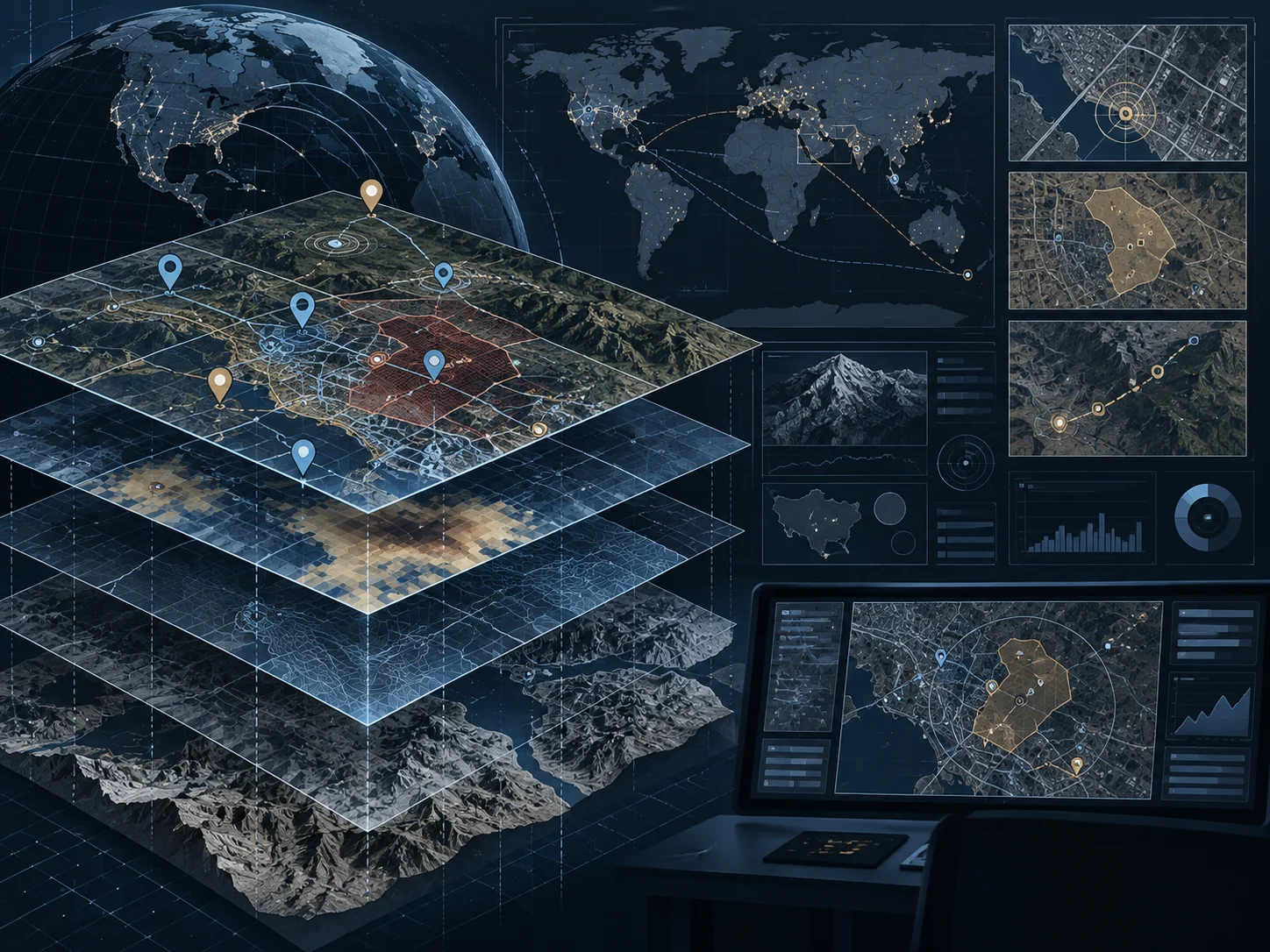
Develop decision-focused maps that bring together authorized incident, asset, event and environmental data. Evaluate proximity, geographic patterns and change across the operating area.
Briefing maps · Layered datasets · Spatial assessments
Develop purpose-built GIS and OSINT applications, interactive mapping tools, dashboards and reporting workflows shaped by your intelligence requirements—not a generic software feature list.
Define requirements · Prototype · Test · Document
Site, event and immediate-area context.
Assets, activity and operating-area relationships.
Regional exposure and cross-border environments.
Data sources, geographic scope, source currency, location accuracy, access controls and delivery format are agreed for each project. Sensitive coordinates, protectee locations and intellectual property stay within the authorized handling scope. Mapping does not imply live tracking; deployment and ongoing application support are scoped separately.
09 / GSOC intelligence support & professional development
Build the requirements, procedures, analytic workflows and professional skills needed to turn multi-source information into documented decisions.

Publius64 supports GSOC intelligence-program design and protective planning with requirements-led research, all-source fusion workflows, reporting procedures and decision-support products.
Program development and analytic support—not a claim of an always-on, staffed response center. Coverage, integrations and response arrangements require an agreed scope.
PIO-EP / Publius64 curriculum
Progressive protective-intelligence OSINT training, practical exercises, custom workshops and curriculum licensing by agreement.
Recognize exposure and threat indicators. Define lawful scope and produce a basic protective-intelligence snapshot.
Ask about Level 1Conduct an authorized protective OSINT inquiry, resolve identities, validate sources and develop operational products.
Ask about Level 2Design, lead, quality-control and brief a continuing protective-intelligence operation through progressive scenarios.
Ask about Level 3Delivery format, prerequisites, dates and licensing are confirmed by consultation. Independently developed professional training; no government endorsement or external accreditation is implied.
10 / Our approach
A clear question at the start. Human review throughout. Conclusions that show both their basis and their limits.
Agree on the purpose, authority, operating environment, information needs and boundaries of the engagement.
Research lawful public sources and authorized records. Establish identity, preserve provenance and minimize personal information.
Test source quality and alternative explanations. Keep facts, judgments, assumptions and intelligence gaps distinct.
Deliver an assessment with proportionate recommendations, clear review triggers and the questions that still need answers.
Exposure is not the same as a threat. Confidence is not a severity rating. Lawful criticism, belief and association are not treated as threat indicators without additional evidence of protective relevance. Assessments support informed decisions; they do not predict violence, establish guilt or guarantee safety.
11 / Start a conversation
All-source intelligence. OSINT investigations. Counterintelligence-informed organizational protection. Competitive intelligence. Leadership analysis. Geospatial intelligence. Protective intelligence. Embedded analytic support. Tell us what decision you need to make and we will discuss an appropriate scope from Salt Lake City & Ogden, Utah.
Detailed service pages
Dedicated pages provide more detail for clients searching for a specific intelligence, investigative, counterintelligence, geospatial or protective-intelligence capability, with a clearly separated sibling-service path for digital infrastructure.
Sibling service: SBDsystems implements infrastructure. Publius64 provides intelligence and risk advisory. When a technology question becomes an exposure, protective-intelligence, investigative, or organizational-risk question, the work can be referred to Publius64 under a separately scoped engagement.